

Microgrids Market - Demand, Competitive Insights, Innovation, Market Size, Share
Microgrids are moving from resilience projects to strategic energy assets reshaping how companies secure power, manage costs and invest in distributed capacity.
Wilmington, DE, United States, Sept. 09, 2026 (GLOBE NEWSWIRE) -- Organizations Relying Solely on Centralized Grids may Soon Face Structural Disadvantages
The conversation around grid reliability has shifted faster than most boardrooms have absorbed. What was once framed as a sustainability commitment has hardened into an operational imperative, and the microgrids market now sits at the intersection of energy security, industrial continuity, and decarbonization economics. Strategy teams still treating distributed energy as an experimental sleeve are negotiating against counterparts who have already moved it into core infrastructure planning.
Outages, climate volatility, and rising industrial electrification have rewritten the calculus for self-sufficient power. The microgrids market is no longer a curiosity for remote installations or defense applications. It has become a mainstream procurement category for hospitals, data centers, manufacturing campuses, and municipalities, and the gap between those who acted early and those still framing business cases is widening quarter by quarter.
Request a Free Sample Report: https://marketmindsadvisory.com/request-sample/?report_id=52
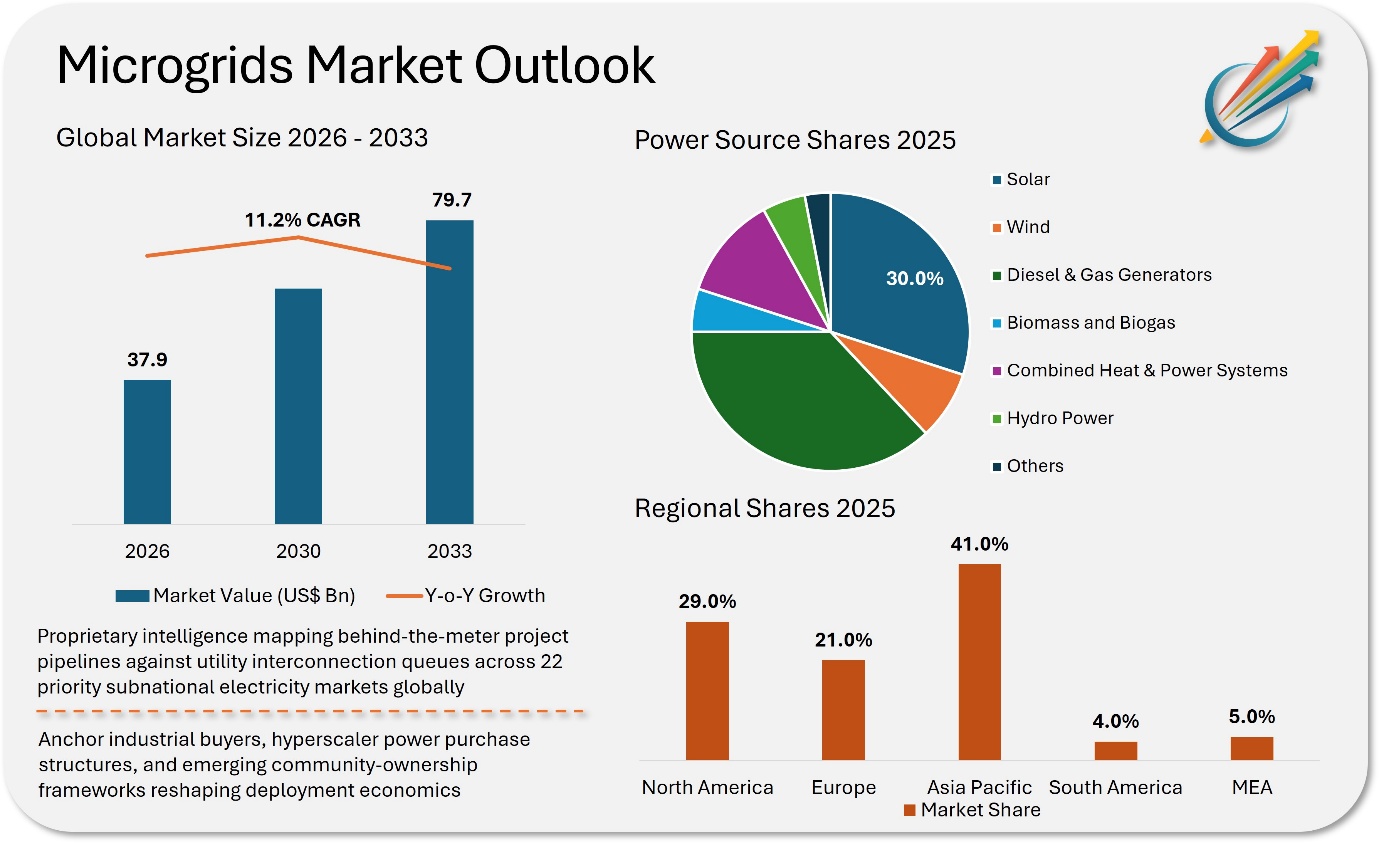
Key Takeaways from Microgrids Market
- The global microgrids market is projected to reach US$ 79.7 billion by 2033, up from US$ 37.9 billion in 2026
- Hybrid configurations combining solar, storage, and conventional generation now dominate new commercial-scale builds
- Data centers and healthcare campuses are emerging as the highest-spending end-user verticals in the microgrids market globally
- Off-grid deployment is scaling fastest across remote mining, defense bases, and underserved rural electrification programs
- Software-defined controllers and AI-led dispatch are reshaping operational economics more than hardware innovation in the microgrids market
- Permitting reform and interconnection backlogs remain the most underappreciated tailwinds for behind-the-meter projects
As per Lead Analyst from Market Minds Advisory, " The microgrids market has stopped being a resilience story and started being a competitiveness one. Companies that lock in integration capability, financing structures, and grid interconnection rights over the coming years will set the cost curve everyone else competes against for the following decade."
Early Movers are Quietly Securing the Most Attractive Positions in Distributed Energy Infrastructure
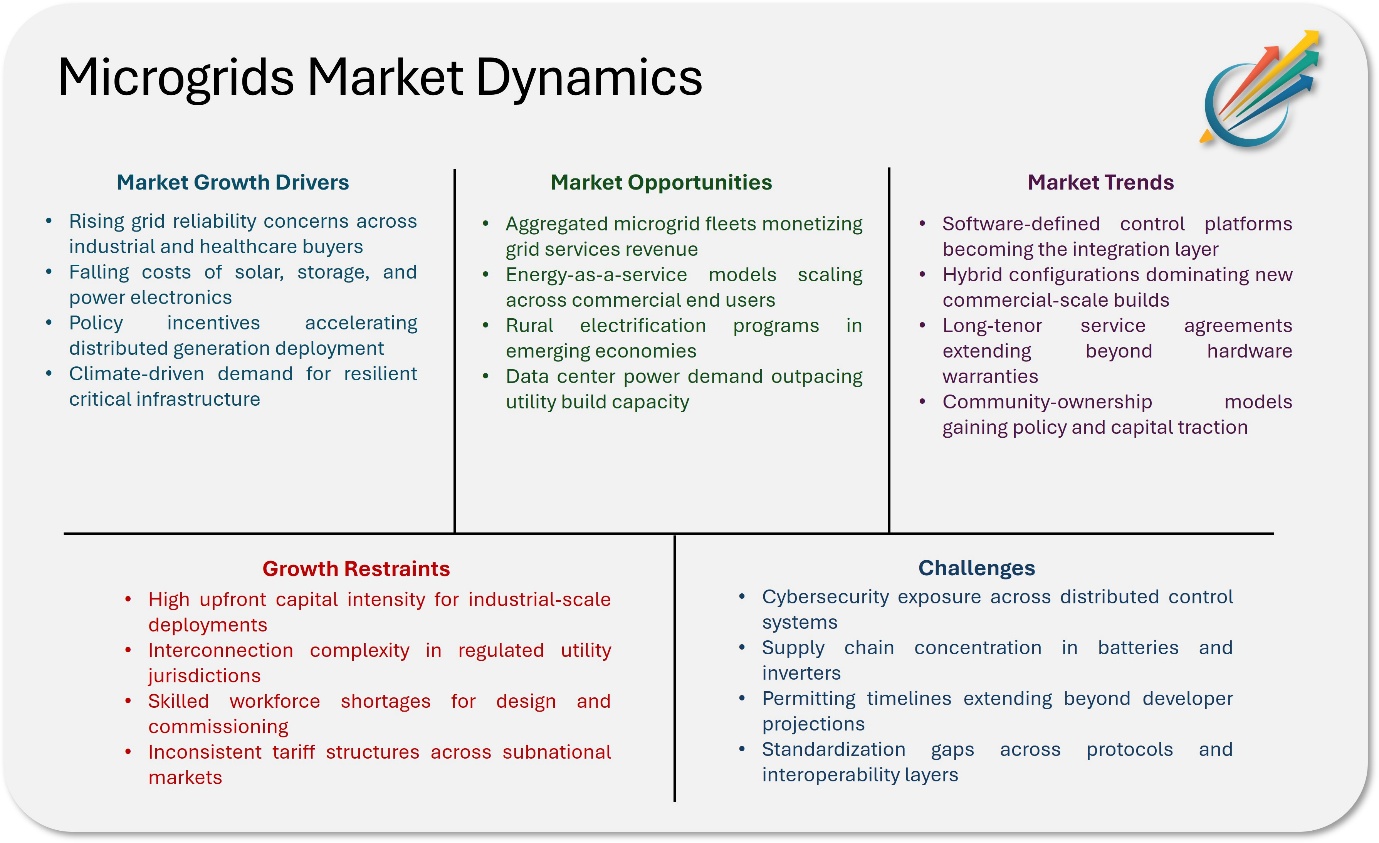
- Interconnection scarcity is now the binding constraint: Utility queues in mature markets stretch beyond five years in several jurisdictions. Behind-the-meter microgrid solutions have become the practical alternative for buyers who cannot wait for transmission upgrades.
- Industrial buyers are signing long-tenor agreements: Manufacturing, logistics, and healthcare operators are increasingly contracting 15 to 20 year energy-as-a-service arrangements, locking in counterparties earlier than past procurement cycles ever suggested.
-
Capital is repricing distributed assets: Infrastructure funds and project finance desks now treat operating microgrids as yield-bearing infrastructure, narrowing the cost of capital gap with utility-scale generation faster than most equipment suppliers have repriced their offerings.
Microgrids Market Is No Longer Defined by Backup Power Economics Alone
The microgrids market is transitioning from a hardware-defined industry to a software-and-services industry. The companies recognizing this shift early are building moats that pure equipment vendors will struggle to dislodge.
- Control platforms are becoming the integration layer: Whoever owns the orchestration layer ultimately owns the customer relationship, the optimization upside, and the recurring revenue stream. Equipment is being commoditized faster than control software.
- Service contracts are extending well past warranty horizons: Asset operators are signing 10 to 15 year operations and maintenance agreements with embedded performance guarantees, fundamentally reshaping how revenue is recognized across the value chain.
-
Aggregation is creating virtual utility-scale assets: Fleets of small commercial microgrids are being aggregated into dispatchable capacity, allowing distributed asset owners to monetize ancillary services historically reserved for centralized generators.
Strategic Outlook Market Realities That Diverge from Consensus Expectations
A meaningful share of announced community-ownership microgrid projects will not reach financial close on original timelines. Permitting complexity, tariff design, and regulatory inconsistency across jurisdictions remain underestimated. The microgrids market will see capital concentrate in jurisdictions that resolve these frictions first, creating sharp geographic winners.
Diesel and gas generation will retain a larger share of hybrid configurations than the decarbonization narrative suggests. Industrial reliability requirements, fuel-flexibility hedges, and capital efficiency are pulling buyers toward pragmatic hybrid designs rather than purely renewable architectures, particularly across emerging economies.
The most defensible margins will not be earned in equipment manufacturing. Integration, financing structures, and long-tenor service contracts will capture disproportionate value. Pure-play hardware vendors without integration capability or capital deployment partnerships will face structural margin compression by the end of the decade.
Distributed Energy Ecosystem is Consolidating around Software, Integration, and Financing Capability
Convergence of Storage and Generation Economics
Lithium-ion price declines have changed the design logic of distributed power. Storage now sits at the center of new microgrids rather than as an afterthought. This convergence is forcing equipment suppliers, system integrators, and project developers to rethink reference architectures, and companies positioned at the storage-generation intersection are capturing value that single-asset specialists cannot access independently.
Rise of Energy-as-a-Service Procurement
End users increasingly prefer outcome-based contracts over capital expenditure ownership. This pulls deployment economics toward integrated providers with balance sheet capacity, project finance expertise, and operational scale. Smaller integrators are being squeezed unless they secure capital partnerships. The microgrids market is consolidating around vertically capable providers who can underwrite long-tenor performance commitments.
Industrial Electrification Surge
Heat pumps, electric process loads, and on-site hydrogen production are pulling industrial customers toward larger, more complex behind-the-meter power systems. The traditional 1 to 5 MW commercial microgrid is giving way to 10 MW plus industrial installations with dispatchable capability, fundamentally reshaping which vendors can credibly bid for the most attractive contracts.
Policy Tailwinds in Permitting and Interconnection
Regulators across mature markets are accelerating permitting reforms, simplifying interconnection rules, and creating dedicated frameworks for distributed assets. These policy shifts compound rapidly when paired with rising utility-scale queue congestion, and they are quietly redistributing where new generation capacity will physically be built over the next decade.
Execution and Interconnection Constraints Could Reshape Market Expansion Paths
- Supply chain concentration: Power electronics, inverters, and battery components remain concentrated in a small number of suppliers, creating execution risk for developers signing fixed-price contracts.
- Tariff and trade volatility: Cross-border duties on solar modules, batteries, and inverter components could compress project economics in jurisdictions reliant on imports.
- Workforce constraints: Skilled labor shortages for design engineering, commissioning, and ongoing operations are tightening, particularly in fast-growing North American and European markets.
- Regulatory inconsistency: Tariff design, exit fees, and standby charges remain unpredictable, and unfavorable rulings in major jurisdictions could stall pipelines.
- Financing structure fragility: Rising interest rates affect long-duration distributed assets disproportionately, particularly community-ownership structures dependent on subsidized capital.
- Cybersecurity exposure: As control platforms become more critical, attack surfaces grow, and incidents could trigger regulatory tightening that raises compliance costs.
None of these risks alter the directional conclusion. They affect pace and geography, not the underlying structural growth case driving sustained deployment across industrial and institutional buyers.
Market Dynamics Shaping the Microgrids Market
Microgrids Market Segmentation
By Power Source
- Solar
- Photovoltaic Systems
- Concentrated Solar Systems
- Wind
- Diesel & Gas Generators
- Biomass and Biogas
- Combined Heat & Power Systems
- Hydro Power
- Others
Solar photovoltaic configurations dominate new builds, supported by falling module costs and storage pairing economics. Combined heat and power retains strong traction across industrial and campus deployments where thermal load is significant. Diesel and gas generators remain structurally relevant in hybrid designs, particularly across remote and emerging-market applications where fuel flexibility and reliability outweigh decarbonization pressures within the microgrids market.
By Connection Type
- On-Grid
- Off-Grid
- Hybrid
Hybrid configurations are now the dominant deployment mode for new commercial and industrial projects, balancing grid resilience with optimization upside. On-grid systems are scaling rapidly behind the meter as interconnection queues lengthen. Off-grid deployment remains structurally important across mining, defense, island nations, and rural electrification programs where the microgrids market addresses fundamental access gaps unreachable by central grid infrastructure.
By Capacity
- Less Than 100 kW
- 100 kW to 1 MW
- 1 MW to 5 MW
- 5 MW to 10 MW
- Above 10 MW
The 1 MW to 5 MW range remains the commercial sweet spot, capturing the bulk of healthcare, education, and mid-market industrial deployments. Above 10 MW installations are expanding fastest, driven by data centers, hyperscale industrial campuses, and electrified manufacturing. Sub-100 kW systems serve residential and small commercial applications where storage-led configurations are reshaping the unit economics of distributed power.
By Technology
- AC Microgrid
- DC Microgrid
- Hybrid Microgrid
AC architectures remain the installed-base default given utility compatibility and equipment availability. DC microgrid adoption is accelerating across data centers and EV charging hubs where conversion losses materially affect operating economics. Hybrid technology configurations are emerging as the strategic middle ground, offering design flexibility for sites combining renewable generation, storage, and conventional loads within the microgrids market.
By Ownership Model
- Utility-Owned Microgrid
- Private-Owned Microgrid
- Public and Private Partnership Microgrid
- Community-Owned Microgrid
Private ownership dominates current deployment volumes, particularly across industrial and commercial end users investing in resilience. Utility ownership is regaining momentum as regulators permit rate-base treatment of distributed assets. Public-private partnerships are scaling across municipal and defense applications. Community ownership remains a smaller but strategically meaningful segment, particularly where policy frameworks support locally controlled energy assets within the microgrids market.
By End Use
- Residential
- Commercial
- Industrial Plants
- Utilities
- Government and Defense
- Healthcare
- Education Campuses
- Remote Communities
Industrial plants and data centers anchor the highest-value contracts, followed by healthcare and government installations where reliability requirements justify premium pricing. Education campuses are emerging as a structured deployment category with predictable financing pathways. Remote communities continue to represent meaningful volume in emerging markets where the microgrids market addresses electrification gaps central utilities cannot economically close.
Shape this report around your priorities: https://marketmindsadvisory.com/request-customization/?report_id=52
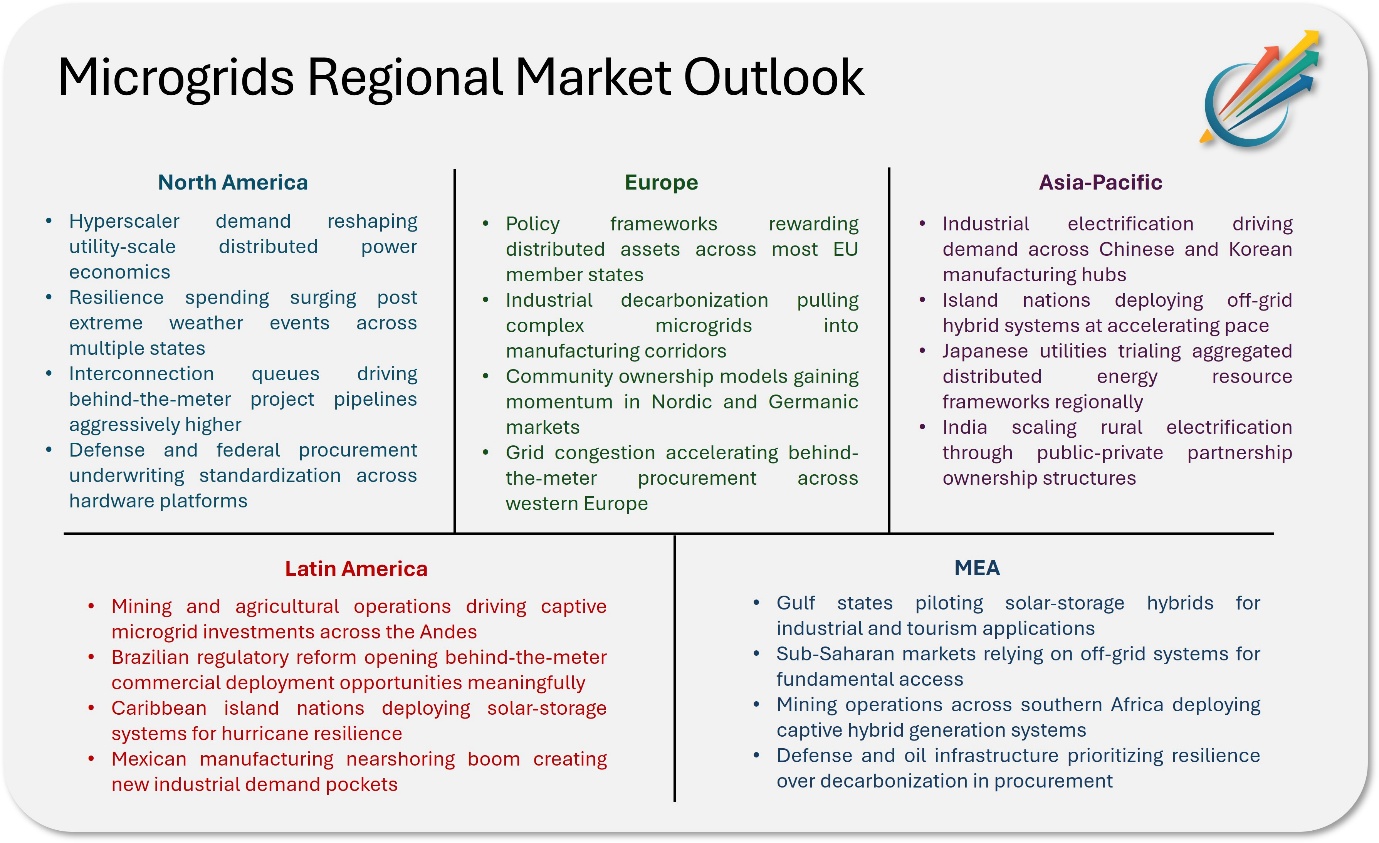
Regional Market Outlook
Investment Focus where the Lucrative Opportunity is Anticipated
Integration and Controls Software
Whoever owns the orchestration layer owns the long-term customer relationship. Software platforms managing dispatch, optimization, and grid services are capturing recurring revenue and increasingly defining competitive economics. Strategic capital is flowing toward control software providers with installed-base reach, where exit valuations are starting to diverge materially from pure hardware vendors across the microgrids market.
Energy Storage Integration Specialists
Storage has become the design center of new builds. Integrators capable of pairing storage with generation, controls, and financing are commanding premium project margins. The companies building proprietary integration capability are creating defensible moats that hardware-only suppliers cannot easily match, particularly as battery cell economics commoditize over the coming five-year horizon.
Energy-as-a-Service Platforms
Outcome-based procurement is reshaping how customers buy distributed power. Platforms offering capital, integration, and ongoing operations under unified contracts are growing faster than traditional engineering, procurement, and construction models. These platforms benefit from compounding portfolio economics and underwriting advantages competitors cannot easily replicate at scale.
Industrial Resilience Specialists
Manufacturing, healthcare, and data center customers represent the highest-margin verticals within the microgrids market. Specialists who understand sector-specific reliability standards, regulatory requirements, and load profiles can command pricing power that horizontal generalists cannot achieve. Vertical specialization is emerging as a more defensible position than broad geographic coverage strategies.
What This Means for Decision-Makers
Energy Companies - The microgrids market is no longer adjacent to core utility strategy. It is becoming central to capacity planning, customer retention, and rate-base growth. Utilities that build distributed asset capability and partnership frameworks now will avoid being structurally disintermediated by behind-the-meter procurement trends.
Industrial Manufacturers - Treating on-site power as a strategic asset rather than a procurement step is now the dividing line between cost leaders and laggards. Long-tenor energy contracts signed in the next 18 months will define operating economics for the following decade across the microgrids market.
Investors - The thesis has matured past pure equipment plays. Integration capability, software platforms, and energy-as-a-service operators offer more defensible risk-adjusted returns than hardware-only exposure. Capital flows are already repricing distributed assets as yield-bearing infrastructure rather than venture-stage technology bets.
Project Developers - The binding constraint has shifted from technology selection to interconnection access, financing structure, and integration capability. Developers without long-term capital partnerships and integration depth will struggle to compete with vertically capable providers winning the most attractive industrial and institutional contracts.
Competitive Landscape: Microgrids Market
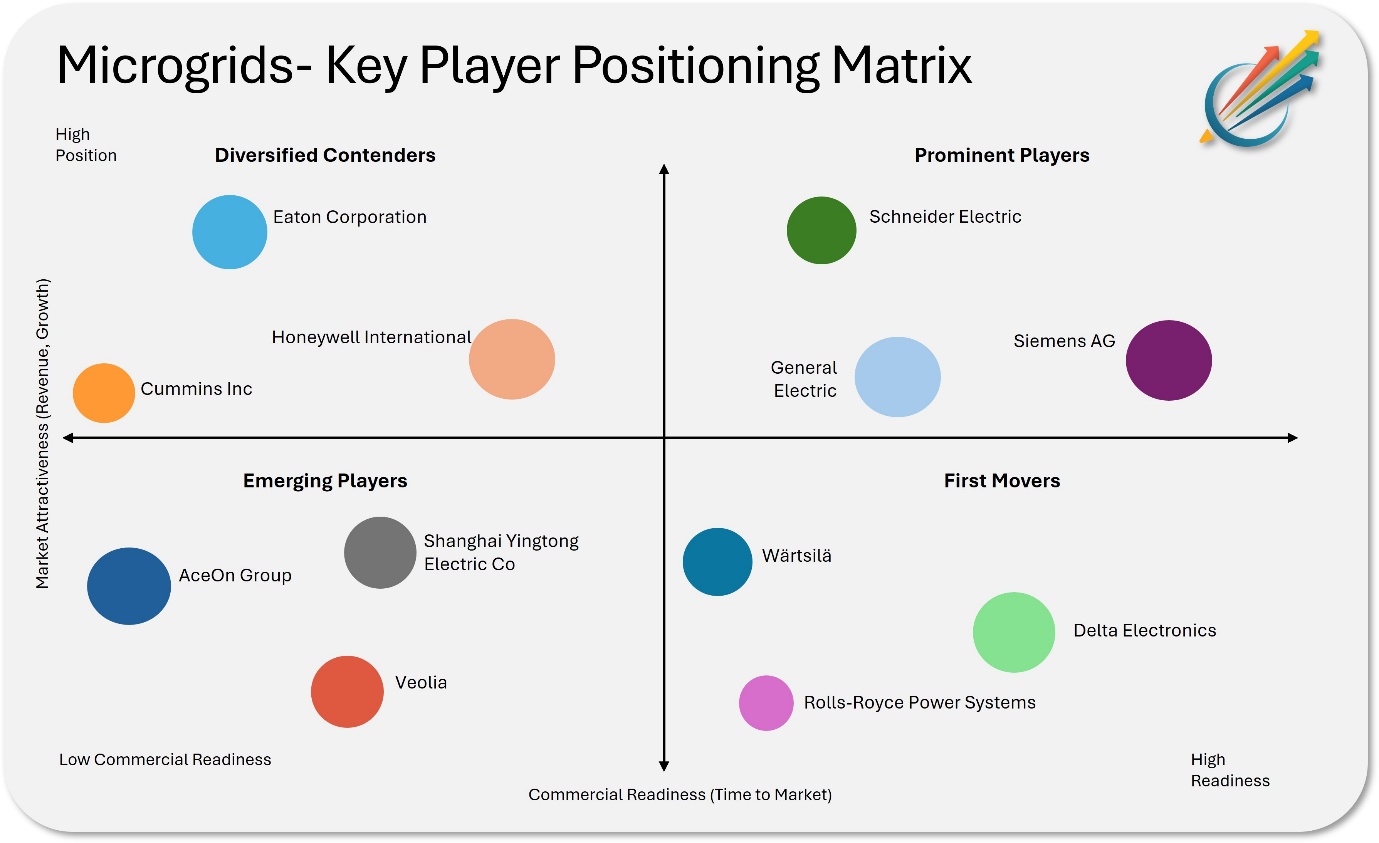
Recent Market Developments
- In March 2026, Schneider Electric expanded its microgrid controls platform with new AI-led dispatch capability targeting commercial and industrial behind-the-meter installations.
- In February 2026, Siemens AG announced a strategic partnership focused on integrated microgrid solutions for data center customers facing utility interconnection delays.
- In December 2025, Cummins Inc broadened its distributed power portfolio by integrating advanced battery storage offerings into its commercial generator product line.
- In January 2026, Bloom Energy secured a multi-site deployment agreement with a hyperscale customer to deliver on-site fuel cell based microgrid capacity supporting AI workloads.
Market is segmented by Power Source (Solar, Wind, Diesel & Gas Generators, Biomass and Biogas, etc), Connection Type (On-Grid, Off-Grid), Capacity (Less Than 100 kW to Above 10 MW), and End Use (Residential, Commercial, Industrial Plants, Utilities, etc)
Get Access to complete Analysis, Buy Now: https://marketmindsadvisory.com/buy-now/?report_id=52
Trending Reports
- High Voltage Direct Current Transmission Market
- Medium Voltage Digital Substation Market
- High Voltage Substation Market
- Industrial Electronic Pressure Switch Market
- Industrial Biofuel Processing Machinery Market
- Industrial Firewall Device Market
- Utility Scale Low Voltage Distribution Substation Market
- Synchronizer for Dual-Clutch Transmissions (DCT) Market
- Surfactants for Enhanced Oil Recovery (EOR) Market
- Steam Methane Reforming Hydrogen Generation Market
Why choose Market Minds Advisory
Market Minds Advisory delivers decision-grade intelligence to executives across machinery, packaging, chemicals, automotive, ICT, food and beverage, consumer goods, and healthcare. We help organizations sharpen market expansion strategies, accelerate share gains, refine brand positioning, and enable account-level growth. Our forecasting integrates primary interviews, proprietary demand models, and continuous market validation, producing the kind of clarity volatile and emerging industries require. Backed by over a decade of sector expertise, our research surfaces white space, opportunity gaps, and competitive blind spots, accounting for recent developments and geopolitical risk. We help businesses see the future of their markets.
Contact Us
Market Minds Advisory
1521 Concord Pike, Suite 301
Wilmington, DE 19803
United States
Email: sales@marketmindsadvisory.com
Website: https://marketmindsadvisory.com/


Legal Disclaimer:
EIN Presswire provides this news content "as is" without warranty of any kind. We do not accept any responsibility or liability for the accuracy, content, images, videos, licenses, completeness, legality, or reliability of the information contained in this article. If you have any complaints or copyright issues related to this article, kindly contact the author above.
